

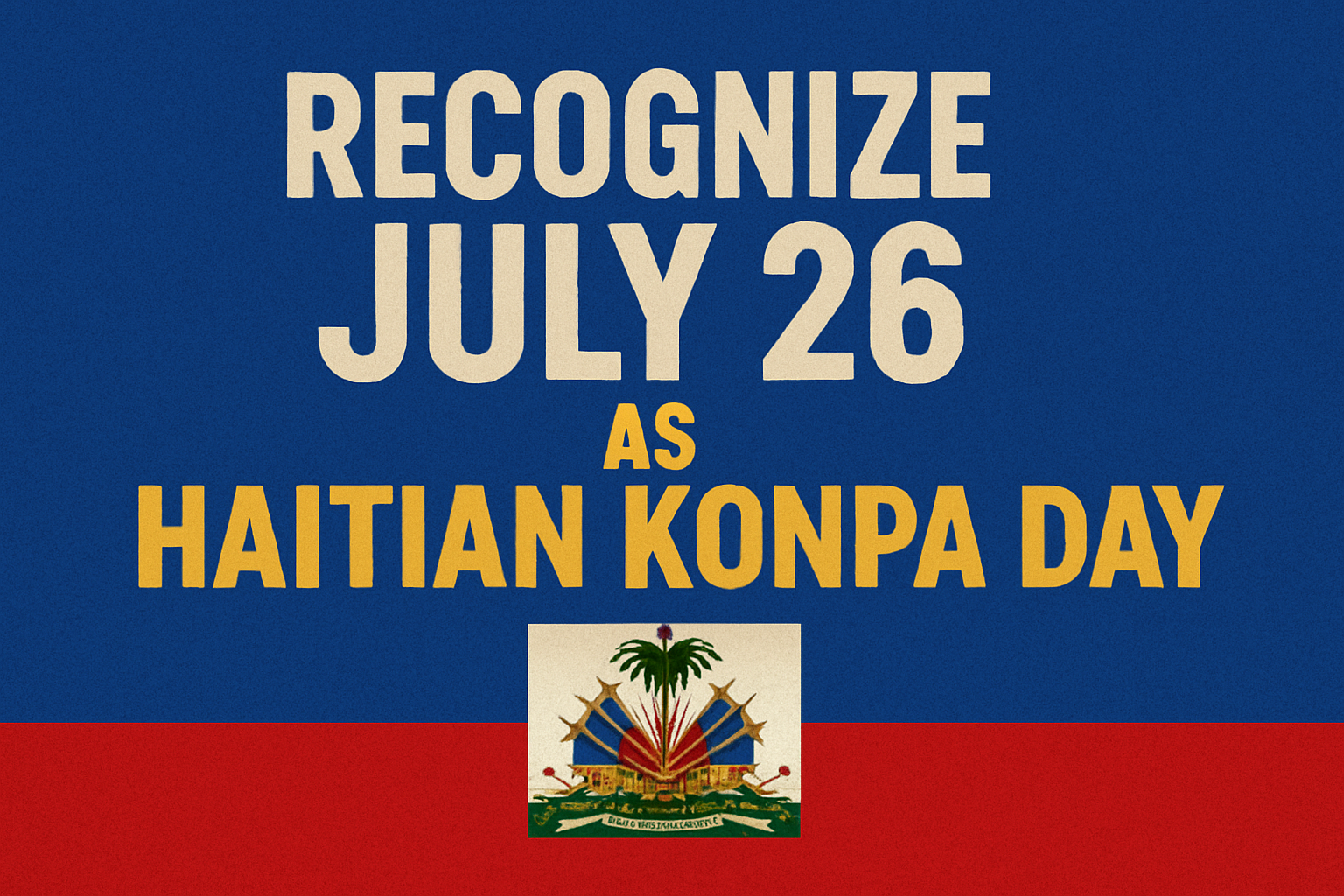
Recognize July 26 as Haitian Konpa Day — Why It Matters for ALL Haitian Communities
Why July 26? The Origins of Konpa (Compas Direct)
The date July 26, 1955 marks a historic moment in Haitian music history. On that day, pioneering musician Nemours Jean‑Baptiste introduced his band (initially known as Coronto International, soon Ensemble Nemours Jean-Baptiste), laying the foundation for the genre known as Konpa (also spelled “Compas”).
Konpa (or Compas Direct) — blending Haitian meringue tradition with modern instrumentation: electric guitar, percussion, brass — quickly became Haiti’s defining dance music genre.
Since then, Konpa has been much more than music — it’s a cultural identity, a symbol of Haitian heritage, dance, community, and diaspora pride.
What Is Resolution 987? How Rita Joseph Is Bringing Haitian Konpa Day to NYC
In late November 2025, New York City Council member Rita Joseph (District 40 — Brooklyn) introduced Resolution 987, which would designate July 26 as “Haitian Konpa Day” across all five boroughs of New York City.
The resolution aims to formally recognize and celebrate Konpa — honoring its roots, its influence among Haitian-Americans, and its role as a unifying musical and cultural force in the diaspora. Le Nouvelliste+1
For many, this is more than symbolic: it’s a public acknowledgment that Haitian music and culture deserve visibility, respect, and preservation — especially in a city built on diversity like NYC.
Why This Recognition Is So Important for the Haitian Community and Beyond
Celebrating Cultural Heritage & Identity
Konpa carries Haitian history, memory, and identity. Recognizing a day dedicated to it affirms the value of Haitian heritage in New York, giving pride to Haitian-Americans — especially younger generations born in the diaspora. A citywide observance helps pass that heritage on.
Visibility, Inclusion & Diaspora Recognition
By enshrining Konpa Day, NYC would join other global cities in acknowledging immigrant cultures and their contributions. This matters for Haitian immigrants and their descendants — giving representation in public discourse, arts, festivals, events, and community life.
Support for Artists, Musicians, Dance Communities & Businesses
A formal Konpa Day encourages concerts, dance socials, cultural events, community festivals — benefiting Haitian artists, DJ’s, dance teachers, cultural organizations, and small businesses tied to Haitian culture (restaurants, shops, event promoters).
Bridging Generations & Cultures
For older immigrants raised on classic Konpa and young Haitian-Americans raised abroad, Konpa Day can be a bridge between generations. It preserves tradition, while also offering a platform for new expressions — fusion, contemporary interpretations, and cross-cultural collaborations.
Challenges & What It Took: Making Konpa Day a Reality
Pushing a resolution like this is not without obstacles. Some of the challenges include:
- Ensuring awareness among non-Haitian lawmakers and community members about the significance of Konpa and Haitian music culture.
- Overcoming bureaucratic processes — securing co-sponsors, drafting official language, gaining votes within city council committees.
- Navigating broad cultural politics and prioritizing recognition among many competing resolutions and causes.
- Making sure the proposed day doesn’t get lost amid other cultural celebrations, ensuring real engagement rather than a symbolic gesture.
That’s why Resolution 987 — championed by Rita Joseph — is so meaningful: it represents both cultural pride and political advocacy.
What Haitian Konpa Day Could Look Like: Visions for July 26 in NYC
If adopted, Haitian Konpa Day could bring:
- Citywide festivals, concerts, street fairs, dance socials highlighting Konpa bands, DJs, and dance groups
- Educational and cultural programming: talks, history panels, workshops on Konpa’s origins, heritage, and evolution
- Recognition for Haitian artists, dance instructors, community leaders
- Community events in Haitian neighborhoods — especially in areas with high Haitian diaspora presence (Brooklyn, Queens, Flatbush/Little Haiti, etc.)
- Greater media visibility for Haitian culture — spreading awareness beyond the Haitian community to New Yorkers of all backgrounds
The Broader Significance: Konpa, Diaspora, Cultural Resilience
Designating Haitian Konpa Day is not only about a single genre or a single community — it’s about valuing immigrant cultures, heritage, and identity in one of the world’s most diverse cities.
It marks an acknowledgment that music = memory, heritage, community, identity. For the Haitian diaspora — in New York, Miami, Boston, Toronto, Montreal, Paris, and beyond — this step validates the stories that travel with them: of Haiti, of migration, of resilience.
It also underscores how diaspora communities contribute to the multicultural fabric of global cities — through music, dance, food, language, and culture.
Conclusion: A Historic Step Toward Cultural Recognition
Recognizing July 26 as Haitian Konpa Day via Resolution 987 is more than a calendar mark — it’s a statement. It says that Haitian music and culture matter. That Konpa — born in Port-au-Prince in 1955 — deserves recognition in one of the world’s greatest cities for immigrants.
For the Haitian diaspora, for New Yorkers, and for multiculturalism everywhere, Haitian Konpa Day would be a chance to celebrate, dance, remember, and unite.